Ancient Fire Arrow
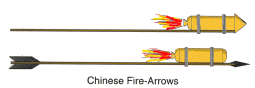
The first true rocket is widely considered to be the ancient Chinese Fire Arrow. Its use was first recorded in 1232 when China was fighting against the Mongols. These first “rockets” where bamboo tubes that where filled with gunpowder and strapped to arrows. The gunpowder would explode and produce an expanding gas that could propel the rocket forward.
Newtons Laws of Motion
In 1686, Isaac Newton proposed three different laws of motion:
- An object at rest remains at rest, and an object in motion remains in motion at constant speed and in a straight line unless acted on by an unbalanced force.
- The acceleration of an object depends on the mass of the object and the amount of force applied.
- Whenever one object exerts a force on another object, the second object exerts an equal and opposite on the first.
(Newtons Laws of Motion by Nancy Hall, NASA)
These laws of motion laid the basis for modern physics and allowed for people to understand the common principles required for movement of objects.
First Liquid Fueled Rocket
In 1926, the first liquid fueled rocket was launched by Robert Goddard. With this rocket, he used combination of gasoline and liquid oxygen to propel the vehicle.
“The rocket rose 41 feet in the air during its 2.5-second flight, landing 184 feet away in a cabbage field. A modest beginning, but like the Wright Brothers’ first brief flight at Kitty Hawk, it ushered in a new era.” (John Uri, Nasa: 95 Years Ago: Goddard’s First Liquid-Fueled Rocket)